
Repeated data entry
Orders or customer records are copied between websites, CRM, accounting and inventory.
Turn disconnected systems into one clear operating flow
Connect websites, CRM, ERP, accounting, inventory, payment and third-party platforms through controlled data flows that teams can monitor and maintain.
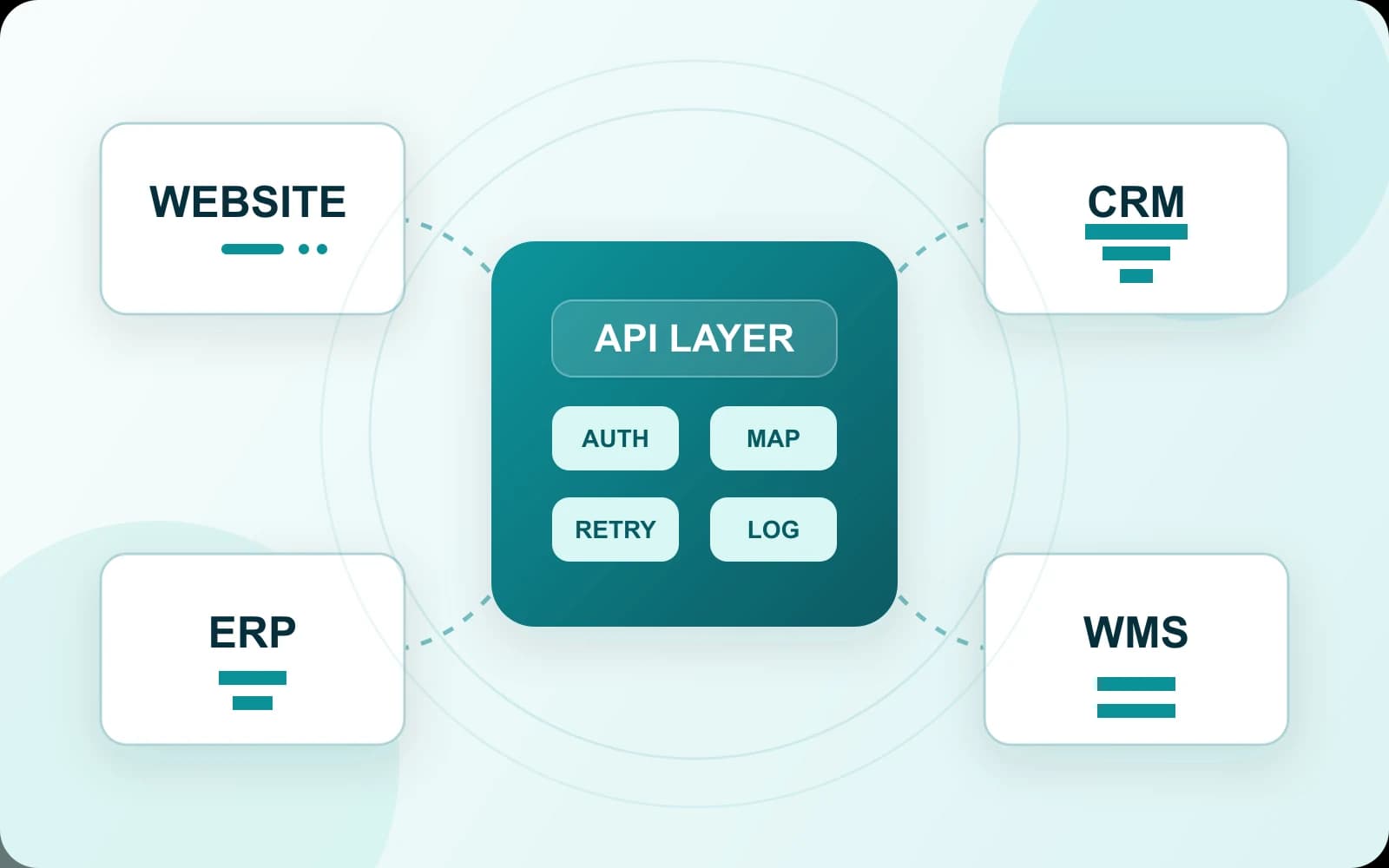
System integration is the design of reliable data exchange between independent applications. APIs, webhooks, queues and scheduled jobs are delivery mechanisms; the real goal is to move data to the right place at the right time, prevent duplicates and recover safely when a dependency fails.
The need usually appears when teams already use several tools but data and operational handoffs remain disconnected.
Orders or customer records are copied between websites, CRM, accounting and inventory.
Different systems show different versions of the same transaction or record.
Existing connections lack useful logs, alerts and clear ownership.
Spreadsheets, email and chat have become the integration layer between teams.
Feasibility depends on each platform's API, access controls and policy. Cyno reviews these constraints before confirming scope.
Send leads, customers and interaction history into a customer workflow.
Synchronize orders, documents or business status through agreed rules.
Connect stock, shipments and delivery status to reduce manual updates.
Receive callbacks, verify status and reconcile transactions against provider documentation.
Synchronize products, orders and status where platform APIs allow it.
Add a controlled API layer to legacy software or connect departmental data.
Cyno defines inputs, data rules, failure handling and operational ownership before development starts.
Source and target systems, data ownership, fields and synchronization frequency.
Endpoints, webhooks, authentication, access limits and suitable versioning rules.
Normalization, input validation, duplicate prevention and update rules.
Timeouts, bounded retries, idempotency, queues or compensation where needed.
Contextual logs, synchronization status, alerts and failure handling guidance.
Acceptance scenarios, technical documentation, configuration and runbooks.
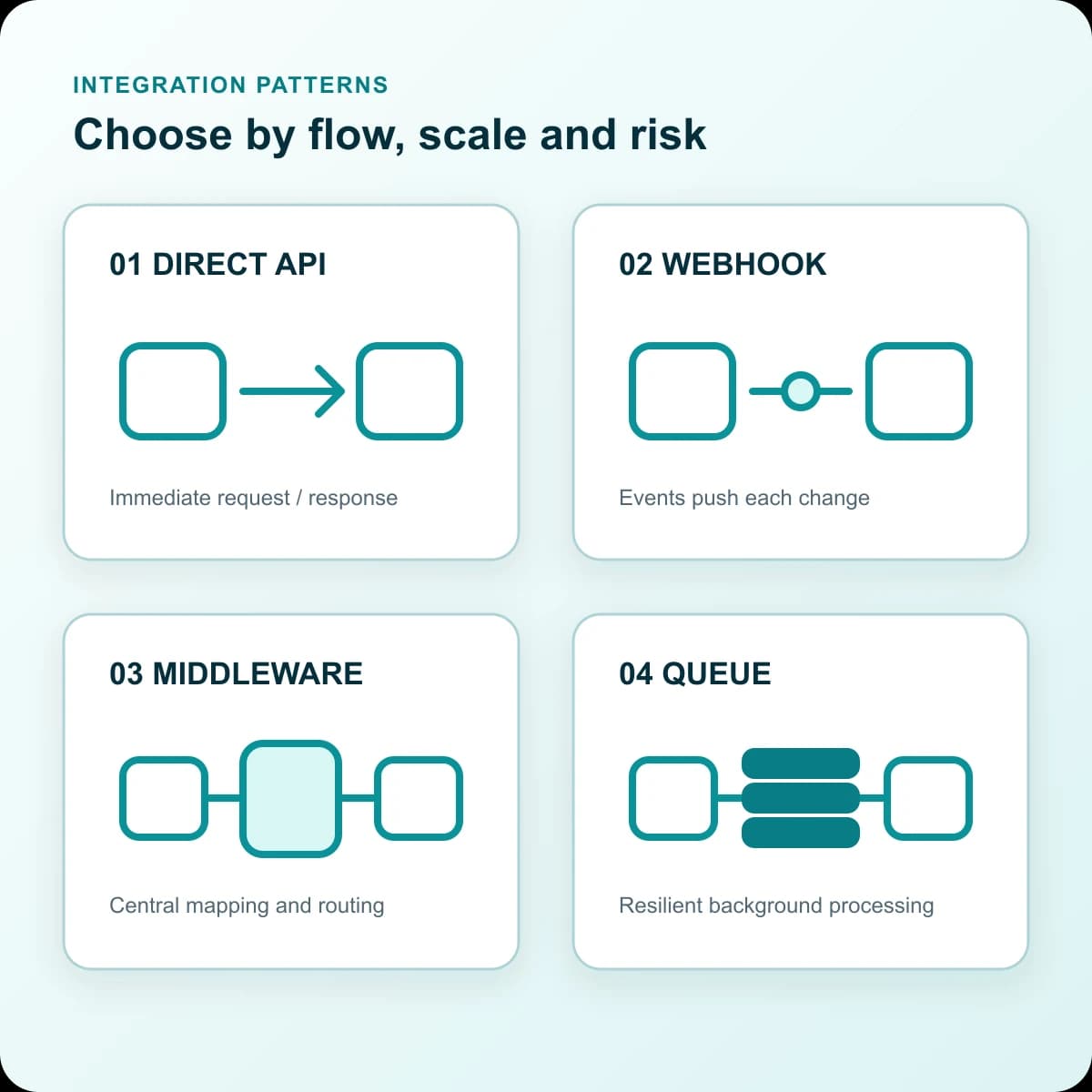
Not every flow needs complex architecture. The design depends on data volume, latency, source-system capability and the operational impact of failure.
A practical fit for simple flows with few systems and immediate responses.
Send changes as events happen instead of continuously polling for updates.
Centralize mapping and orchestration when several systems must coordinate.
Decouple processing for load tolerance and recovery during temporary outages.
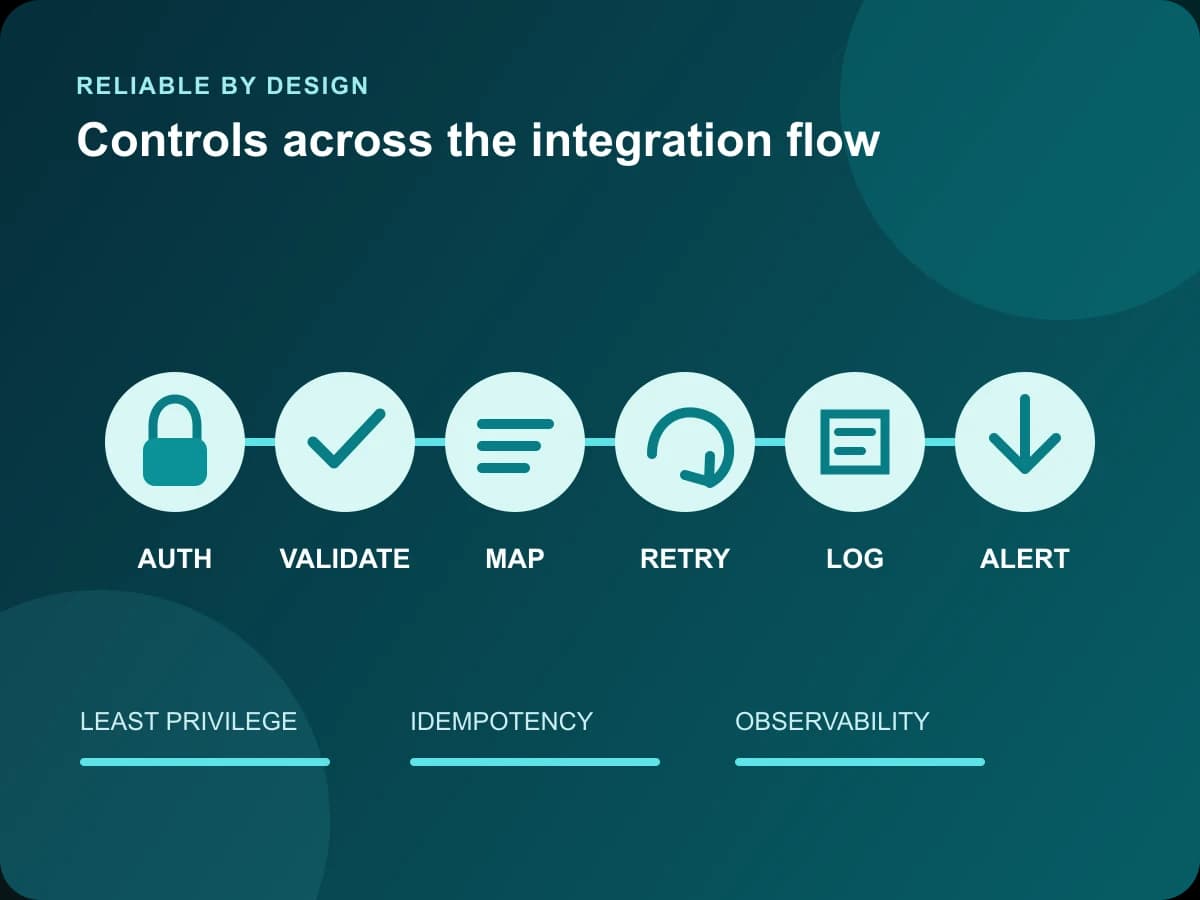
An integration is useful only when data is protected, failures are observable and the operating team knows how to respond.
Store secrets outside source code in environment variables or an appropriate secret manager
Authenticate and authorize with least-privilege access
Validate inputs and limit payload size or request rate
Encrypt connections and keep sensitive values out of logs
Use idempotency where duplicate transactions would cause harm
Apply bounded retries, backoff and a place for unresolved failures
Monitor status, alert owners and define reconciliation routines
Review systems, users, data and current operational bottlenecks.
Agree sources, targets, direction, triggers and acceptance criteria.
Plan architecture, authentication, mapping, failures and testing.
Develop adapters or APIs, configure environments and add useful logs.
Test success, invalid data, timeouts, duplicates and access controls.
Deliver documentation, access, alerts and an agreed support plan.
An estimate follows discovery because system count alone does not capture data quality, business rules or reliability requirements.
Estimate factors
Number of systems and data flows
API documentation quality and sandbox access
One-way, two-way or near-real-time synchronization
Data volume, migration history and reconciliation rules
Monitoring depth, support SLA and security requirements
One focused flow to validate value, technical constraints and collaboration.
Several sources and targets with mapping, orchestration, monitoring and centralized documentation.
Review existing connections, improve visibility and reliability, and replace components in stages.
01Systems to connect and the owner of each system
02What data should move from where to where
03Expected frequency, volume and response time
04API documentation, sandbox accounts or sample files if available
05Current failure scenarios and their operational impact
Questions to clarify before confirming architecture and scope.
API integration creates a data path between systems. Workflow automation uses data and events to coordinate work. A project may require both, but scope and acceptance criteria should remain explicit.
It requires an architecture and access review. Options may include controlled import/export, a middleware layer or a partial upgrade. Cyno does not modify production data directly without safeguards and a rollback path.
No. Batch or scheduled synchronization is often simpler and more economical. Real-time behavior should be reserved for workflows where delay materially affects operations.
The design may use timeouts, bounded retries, queues, alerts and a manual recovery process. The exact controls depend on impact and provider capabilities.
No. Secrets are configured outside source code through environment variables or a suitable secret-management mechanism for the agreed infrastructure.
Potentially, after defining data types, processing purpose, access, encryption, logging and retention. Security scope must be agreed before development.
Both parties agree on scenarios for valid data, invalid data, duplicates, timeouts and permissions. Acceptance is based on observable flow outcomes, not only successful endpoint responses.
Support can be included. Response times, monitoring scope and responsibility for third-party platforms are defined separately in the proposal.
Cyno will help define the priority flow, technical constraints, operating risks and a scope clear enough to estimate.